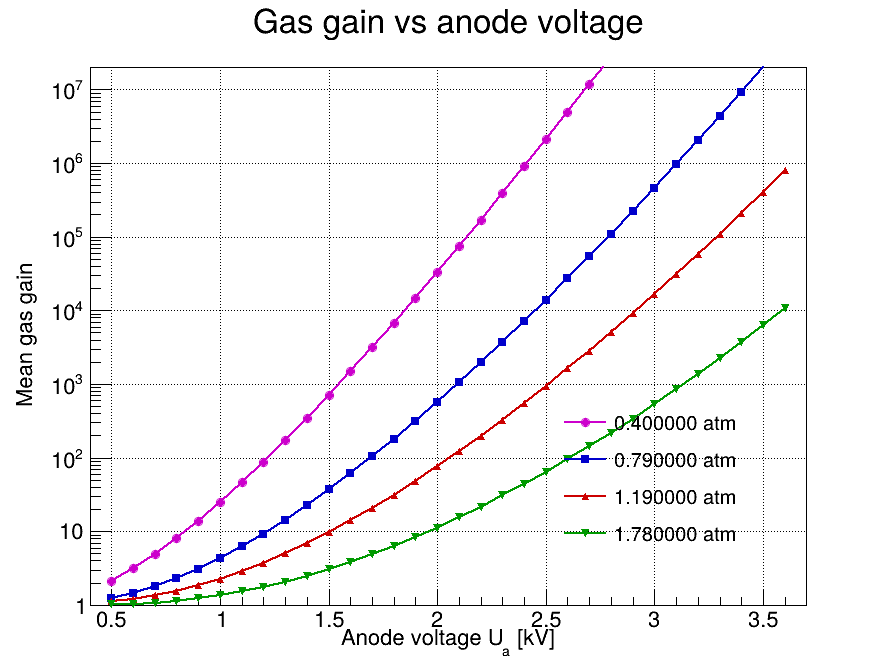
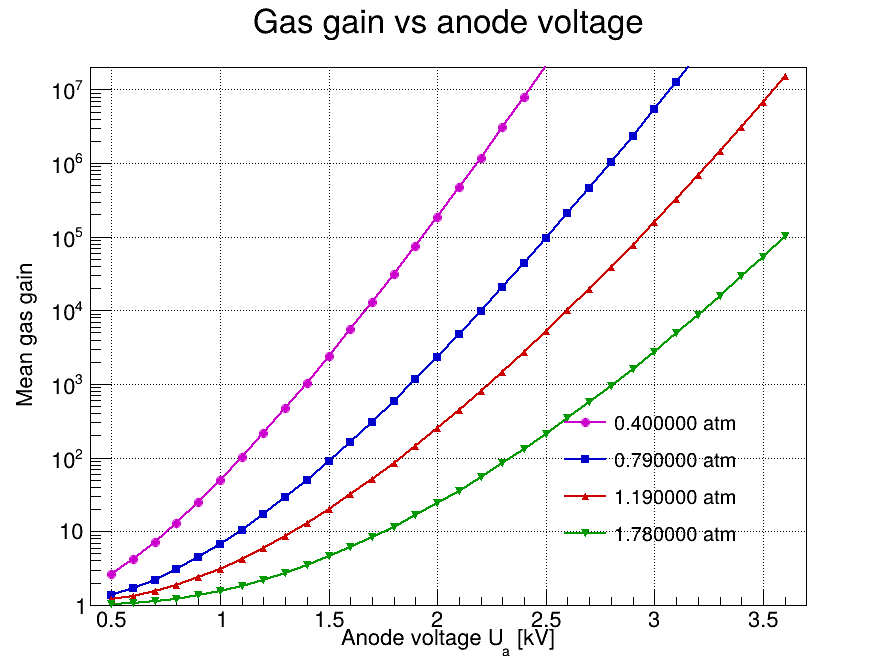
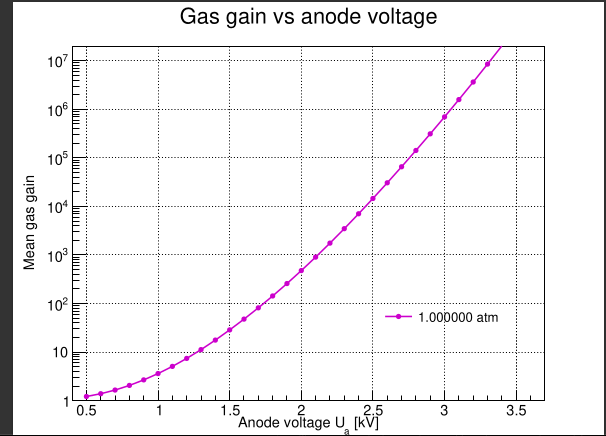
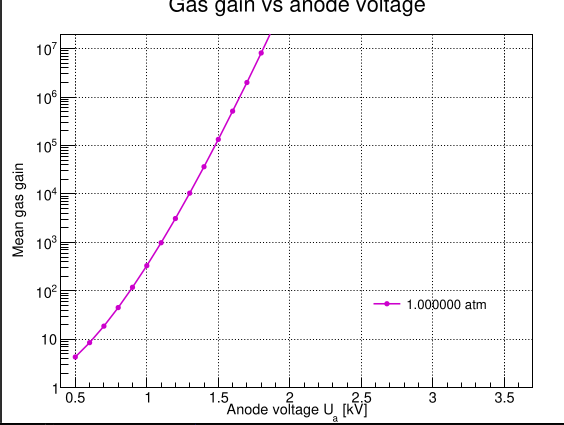
I guess what you are seeing in the plots is the gain with penning transfer off. The gas tables are standardly calculated without penning effect. Instead when you call the function gas.EnablePenningTransfer() the townsend coefficient will be updated by reading the ionisation and excitation rates in the gas table.
Can you try to run your program again, but with the function call gas.EnablePenningTransfer() placed after you have calculated the gas tables?
It is a bit subtle, and one needs to read carefully the documentation, which is - agreed - a bit minimalistic. An important point to consider is that there is “macroscopic” transport of charged particles that requires gas tables to look up the swarm parameters (such as Townsend’s alpha) and “microscopic” transport that requires only a set of electron-atom cross sections.
If you work with the microscopic transport, then this is sufficient:
It is done correctly in this “official” example. Note that for known gas mixtures (Ar:CO2) you can just call EnablePenningTransfer() without arguments, while for other mixtures you have to pass the arguments.
You might also like to “check” other examples where “EnablePenningTransfer” is present (I only “checked” these that explicitly call “GenerateGasTable” or “LoadGasFile”).
I think I’d like to propose the following modification of the “Penning transfer” tutorial:
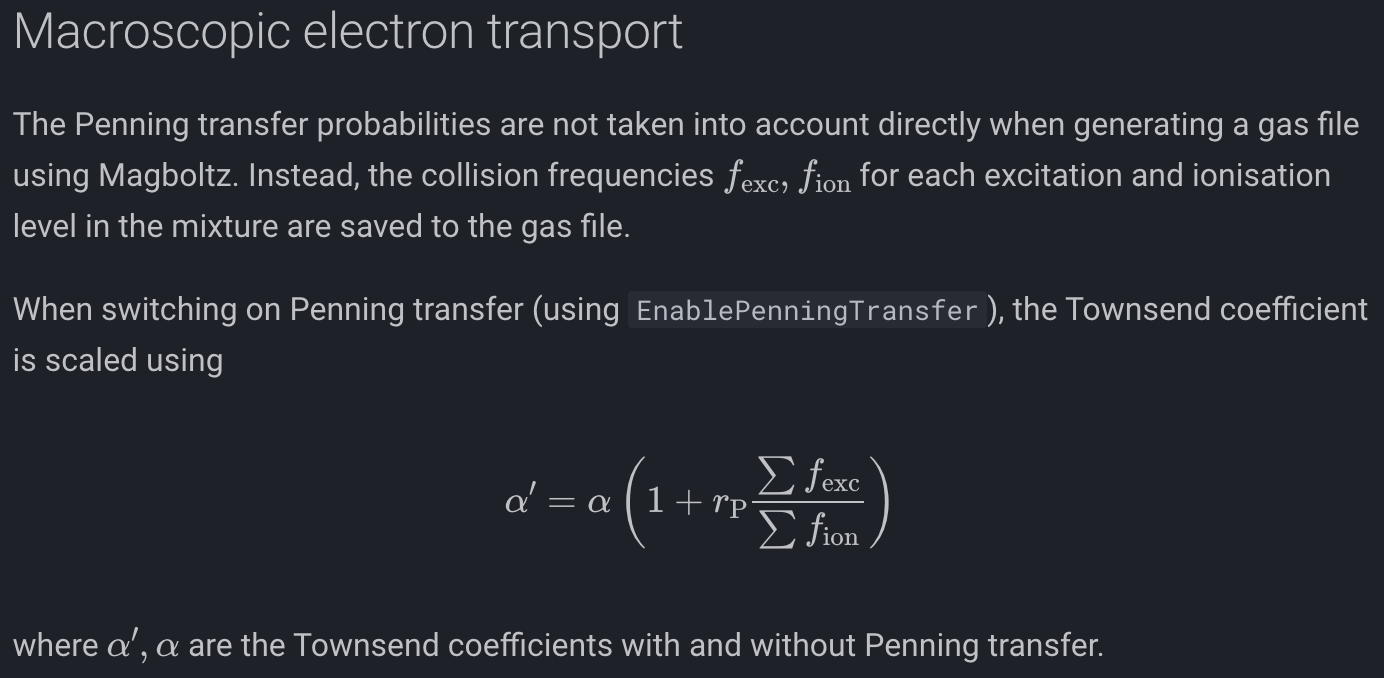
“When switching on Penning transfer (by calling EnablePenningTransfer after the gas table has been generated or loaded), the Townsend coefficient is scaled using”
Also, maybe a similar explicit note in the “UserGuide” would be helpful.
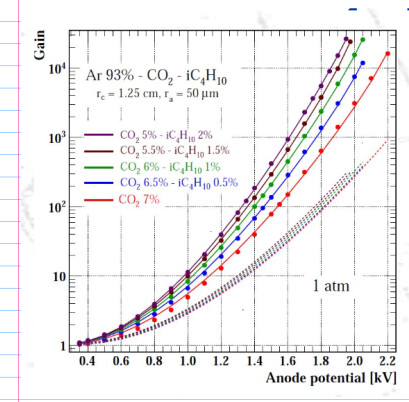
I tried two options: before the transfer parameters table and after it for a mixture of argon, CO₂ and isobutane. I took the transfer parameters from there[1]. Without Penning the result is less than in the article [1] , and with it it is much more.
Also the console also produced warnings:
Warning: Integrating the Townsend coefficients would lead to exponential overflow.
Avalanche truncated.
DriftLineRKF::Avalanche:
Warning: Integrating the Townsend coefficients would lead to exponential overflow.
Avalanche truncated.