So I decided to investigate further and found this happens with the graph……
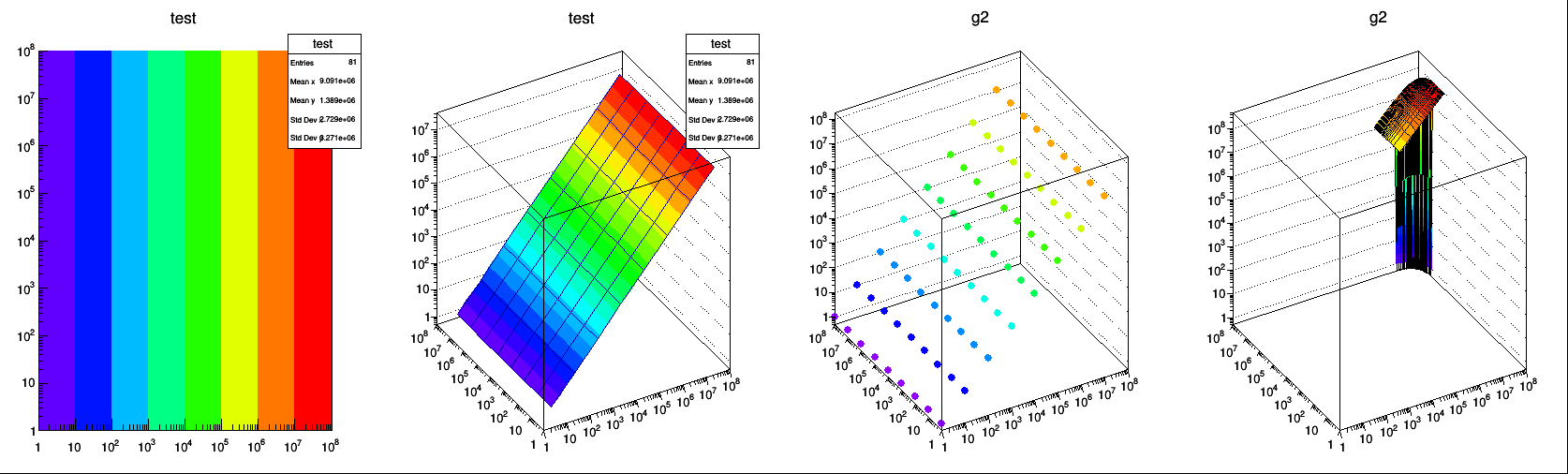
from this code
{
void HistyIssue() {
	vector<double> Xvals{ 1,10,100,1000,10000,1e5,1e6,1e7,1e8 };
	vector<double> Yvals{ 1,10,100,1000,10000,1e5,1e6,1e7,1e8 };
	int dtpoints = (int)(Xvals.size()*Yvals.size());
	TH2F* test = new TH2F("test", "test", Xvals.size() - 1, &(Xvals[0]), Yvals.size() - 1, &(Yvals[0]));

	double* X = new double[dtpoints];
	double* Y = new double[dtpoints];
	double* Z = new double[dtpoints];

	for (int i = 0; i < (int)Xvals.size(); i++) {
		for (int j=0; j < (int)Yvals.size(); j++)	{
			// for the tgraph
			int itt = i * (int)Xvals.size() + j;
			X[itt] = Xvals[i];
			Y[itt] = Yvals[j];
			Z[itt] = TMath::Power(10,i);
			//fill hist
			test->Fill(Xvals[i], Yvals[j], Z[itt]);
		}
	}

	TCanvas* C1 = new TCanvas();
	C1->Divide(4);

	//hist
	C1->cd(1);
	gPad->SetLogx();	gPad->SetLogy();	gPad->SetLogz();
	test->SetMarkerSize(1);
	test->SetMarkerStyle(20);
	test->Draw("Pcol");

	C1->cd(2);
	gPad->SetLogx();	gPad->SetLogy();	gPad->SetLogz();
	test->Draw("Surf1");


	//another proof of madness
	TGraph2D* g2 = new TGraph2D("g2", "g2", dtpoints-1, X, Y, Z);
	C1->cd(3);
	gPad->SetLogx();	gPad->SetLogy();	gPad->SetLogz();
	g2->SetMarkerSize(1);
	g2->SetMarkerStyle(20);
	g2->Draw("Pcol");

	C1->cd(4);
	gPad->SetLogx();	gPad->SetLogy();	gPad->SetLogz();
	g2->Draw("Surf1");

}
}
does the ‘surf’ option do some sort of averaging over and area?